







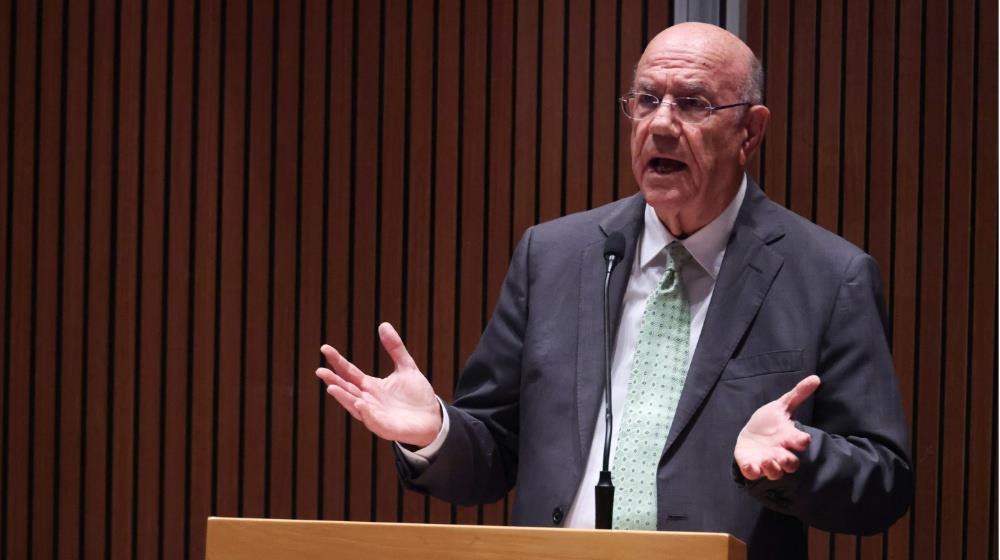
The Cyprus Presidency of the Council of the European Union has significantly contributed to the promotion of important legislative files in the areas of economy and fiscal affairs, enhancing the competitiveness of the European economy, modernising the customs union, integrating capital markets, fostering tax cooperation, and supporting Ukraine, Finance Minister Makis Keravnos has said.
He was speaking on Tuesday, 14, July, presenting the outcomes of the Cyprus Presidency in his area of responsibility.
During a press conference in Nicosia, Keravnos described the six-month Presidency as a particularly demanding yet highly productive period, noting that Cyprus took the helm of the Council at a time of intense geopolitical upheaval, with the war in Ukraine, the conflict in Gaza, developments in the Middle East, and their impacts on the European economy and energy security.
As he pointed out, these conditions necessitated decisions that would strengthen the competitiveness and resilience of the European Union, with the Cypriot Presidency focusing on policies that promote sustainable development, fiscal stability, and the enhancement of the Union's strategic autonomy at the Council of Economic and Financial Affairs (ECOFIN).
The Minister said that during the Cypriot Presidency, he chaired five ECOFIN meetings, a General Affairs Council on cohesion policy issues, as well as informal meetings of EU Finance Ministers and Central Bank Governors and Ministers responsible for Cohesion Policy that were hosted in Cyprus.
He further pointed out that a central goal of the Presidency was to strengthen the financial autonomy of the European Union and create conditions for greater productivity and competitiveness of the European economy.
Keravnos made particular reference to the work on the Union of Savings and Investments, describing it as a key pillar of European competitiveness. At the same time, he noted that the Council reached agreements on a series of legislative proposals concerning supplementary pensions and specifically the revision of the pan-European personal pension product (PEPP), to make it more attractive, accessible, and financially sustainable.
Referring to the first pillar of the Presidency, the Minister emphasised the implementation of the new EU economic governance framework agreed upon in 2024, as well as the coordination of member states' economic policies through the European Semester. He also said that the Cypriot Presidency contributed to resolving outstanding issues that delayed the implementation of a decision to grant a loan of 90 billion euros to Ukraine.
Keravnos also referred, among other things, to the progress made on the European budget and the new Multiannual Financial Framework for the period 2028-2034. Regarding taxation, he said that new rules were agreed upon for more effective combating of VAT fraud, through enhanced cooperation between member states, the European Public Prosecutor's Office, and the European Anti-Fraud Office (OLAF). He also spoke of the reform of the Union Customs Code, which he described as the most significant since the establishment of the customs union in 1968.
"Cyprus has proven that it has the human resources that can not only address national issues but also design and implement European policies," he said, adding that the successful completion of the Presidency enhanced the voice and credibility of the country in European institutions.
(Source: CNA)
