








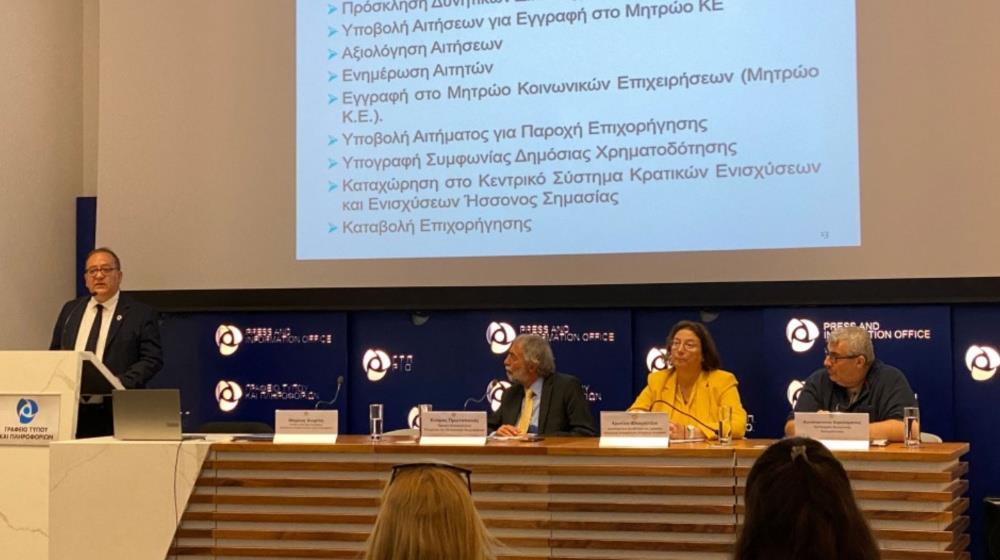
Three social companies have already been registered in the social enterprises registry, with two more preparing to submit registration documents, Commissioner of Cooperative Companies and Social Enterprises, Kypros Protopapas, has said.
Speaking during a press conference in Nicosia on 3 July, Protopapas said that two out of these five companies are focusing on the integration of people with disabilities.
During the conference, Marinos Aniftos, Head of the Promotion Unit for Cooperative Institutions and Social Entrepreneurship, explained that the legislation enacted in 2023 provides for two types of social companies: general-purpose enterprises and integration enterprises, with the latter category focusing on the inclusion of people with disabilities in the workforce, through the employment of at least 10% individuals with disabilities and at least 30% individuals from vulnerable groups.
Aniftos explained that at least 70% of the revenues of a registered social enterprise must come from business activities, providing goods and/or services based on a business model. For enterprises in the general-purpose category, he said that at least 80% of the profits after taxes must be reinvested (transferred to undistributed reserves). Correspondingly, for integration enterprises, at least 40% of their profits after taxes must be reinvested (transferred to undistributed reserves).
Aniftos also presented the state grant scheme, providing one-time fund of €10,000 per enterprise for basic expenses. The available fund amounts to €600,000 for 2026-2027. Eligible applicants can submit applications for grant provision, following an open call posted on the Service's website (www.gov.cy/cssda).
The Department of Social Integration of Persons with Disabilities of the Ministry of Social Welfare provides additional support and funding for integration social entreprises, Christina Flourentzou said during the press conference, emphasizing the need for incentives for the employment of persons with disabilities, as part of their social integration.
In this context, she said that an additional grant scheme is implemented, offering funding up to €10,000 per beneficiary, up to €30,000 per social enterprise, and up to 30% for working capital. Flourentzou noted that beneficiaries are individuals with disabilities, Cypriot or European citizens with permanent residence in the areas controlled by the Republic of Cyprus, aged 18-63, unemployed or salaried individuals who are participating for the first time and are employed in a social enterprise, who will submit an application with a business plan and feasibility study.
(Source: CNA)
