





As global shipping faces mounting pressure to decarbonise while navigating growing geopolitical uncertainty, the International Maritime Organization (IMO) finds itself at the centre of a defining transition for the industry.
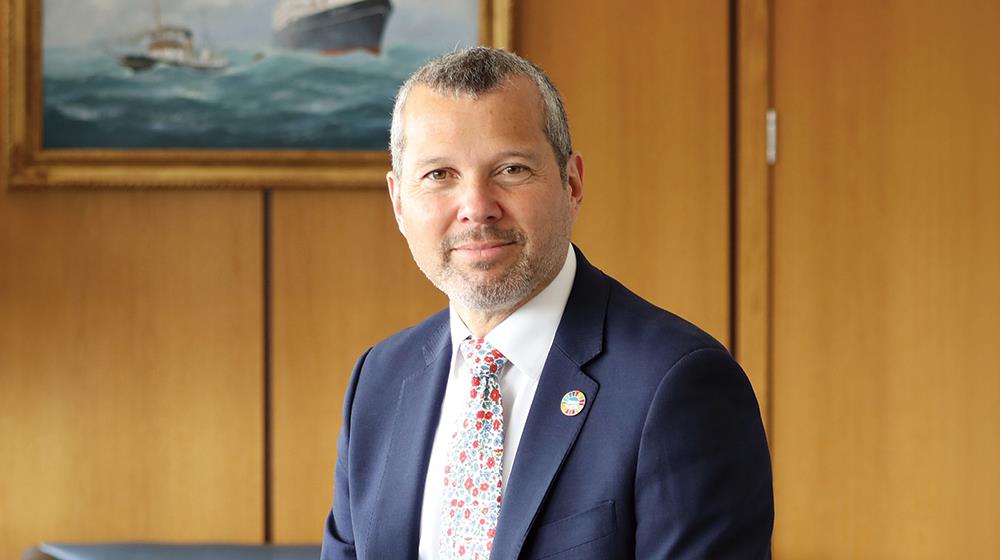
In this interview with GOLD magazine, IMO Secretary-General Arsenio Dominguez discusses the momentum behind maritime decarbonisation, the challenge of achieving global consensus, and why free navigation and international cooperation remain essential to the future of global trade.
In January, you said that shipping decarbonisation “has already started” regardless of political delays. Does this mean that the industry is moving faster than governments or is it being forced to improvise in a vacuum of regulatory clarity?
Regulation has already driven significant progress. Existing IMO measures have reduced the carbon intensity of international shipping by more than 38% compared with 2008, proving that efficiency gains and fuel saving actions are achievable today. Mandatory requirements began in 2011 with the adoption of the Energy Efficiency Design Index (EEDI) for new ships and the Ship Energy Efficiency Management Plan (SEEMP) for all ships, followed by the “short term measures”, which require every ship to calculate its Energy Efficiency Existing Ship Index (EEXI) and report annual Carbon Intensity Indicator (CII) data and ratings since calendar year 2023.
With the 2023 IMO GHG Reduction Strategy, Member States committed to developing mid-term measures to further incentivise decarbonisation. Meanwhile, industry is not waiting: orders for dual fuel vessels and the creation of green corridors show strong momentum. This reflects both regulatory direction and industry ambition to reach net zero emissions by or around 2050, rather than a vacuum of political clarity.
Speaking at the Blue Economy Finance Forum in Monaco last summer, you argued that regulation alone cannot drive maritime decarbonisation and that only investment in technology and alternative fuels will deliver real change. How can IMO move beyond rule-setting to actively catalyse the scale of investment the industry now urgently needs?
Regulation alone cannot deliver the scale of transformation required. IMO is therefore supporting decarbonisation through targeted capacity building, especially for developing States, to ensure an equitable transition. This includes assistance in developing National Action Plans, support for pilots and trials of energy efficient technologies and alternative fuels, and the use of data to improve operational efficiency. Training and knowledge sharing are central pillars of this work, including through platforms such as futurefuels.imo.org. These initiatives help create the enabling environment that investors and innovators need. I am grateful to the donors whose support allows IMO to help ensure that no country is left behind.
You recently stressed that no country can lawfully restrict navigation through critical chokepoints such as the Strait of Hormuz. In today’s geopolitical climate, how resilient is the principle of free navigation? And as geopolitical tensions increasingly shape maritime routes and risk exposure, is IMO being drawn into the role of mediator in power politics?
The principle of free navigation remains fundamental. No State may lawfully restrict transit through key chokepoints such as the Strait of Hormuz. IMO has served as the global forum for maritime issues since the convention establishing IMO entered into force in 1958, and Member States continue to bring concerns to the Organization, as seen during the Extraordinary Council Session in March. My role is to engage all Member States, encourage dialogue and uphold core principles: freedom of navigation, the safety of seafarers, the imperative that seafarers must never be used as geopolitical leverage, and the need for diplomacy to restore stability. IMO is a platform where maritime security concerns can be addressed multilaterally.
With the EU advancing its own green shipping regime, does regional action, such as the EU Emissions Trading System (EU ETS), serve as a catalyst for global progress or does it risk eroding IMO’s authority as the primary international standard-setter?
Shipping is inherently global and requires universal, global regulations applied uniformly and consistently to all ships. IMO has demonstrated its authority as the global standard setter for seven decades. The strong engagement at the recent Marine Environment Protection Committee (MEPC 84) – with the participation of more than 2,000 delegates from more than 150 Member States – shows continued confidence in IMO’s central role in the global regulation of shipping.
Following the postponement of discussions on the IMO Net-Zero Framework and their subsequent resumption, what are the next steps? What should we expect going forward?
Work is continuing, to build consensus on a global mid- term measure. At MEPC 84, more than 100 delegations presented views and proposals on the Net Zero Framework. The Committee agreed to establish an Intersessional Working Group to address outstanding concerns ahead of MEPC 85 (in six months). Two intersessional meetings (1–4 September and 23–27 November) and a one day expert workshop on chain of custody models will support this work. The second extraordinary session of MEPC, adjourned last October, is scheduled to resume on 4 December, subject to progress at MEPC 85.
Looking ahead, as vessels become increasingly digitalised and autonomous, what does this mean for the maritime workforce?
The seafarer workforce needs to be agile and adaptable. Seafarers are central to maritime safety and the sustainable operation of ships and their expertise and resilience underpin the shipping industry’s ability to adapt to new technologies, digitalisation and decarbonisation. IMO is undertaking a comprehensive review of the International Convention and Code on Standards of Training, Certification and Watchkeeping for Seafarers (STCW), a multi-year process, while also issuing interim training guidelines applicable across fuels and technologies. Seafarers make global shipping possible and continued support for the workforce is essential as the industry evolves.
This interview first appeared in the May edition of GOLD magazine. Click here to view it.