





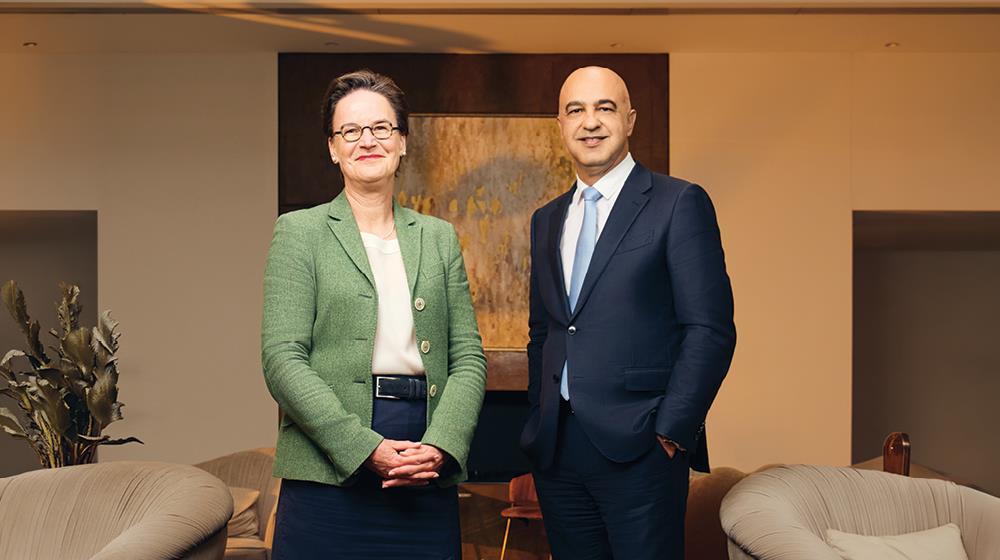
On the occasion of the 30th anniversary of the Cyprus Securities and Exchange Commission (CySEC), and the meeting of the European Securities and Markets Authority (ESMA) Management Board and Board of Supervisors, the respective heads of the two authorities – Dr George Theocharides and Verena Ross – discuss the latest developments in market regulation, in particular the effect of the Markets in Crypto-Assets Regulation (MiCA), and other key issues.
Speaking to GOLD magazine, the two also talked about the significance of CySEC hosting the meetings and how the body is aligning its supervisory practices with ESMA’s convergence priorities.
Among other things, Theocharides and Ross, in addition, discussed to what extent ESMA should evolve into a more centralised supervisor, particularly for cross-border firms and systemic entities, while also weighing in on Retail Investment Strategy (RIS) proposals.
Other topics covered in the interview included but were not limited to where they see the most significant emerging risks from a Cypriot perspective.
What is the significance of CySEC hosting the meetings of the ESMA Management Board and the ESMA Board of Supervisors in Cyprus?
George Theocharides: Hosting the meetings of the European Securities and Markets Authority (ESMA) Management Board and Board of Supervisors in Cyprus is both symbolic and substantive. It reflects Cyprus’ active role within the European supervisory framework and reinforces its commitment to regulatory convergence across the EU. As Cyprus currently holds the EU Presidency, hosting these high-level meetings forms part of its institutional responsibilities while also providing an opportunity to contribute directly to shaping European supervisory priorities.
This occasion is particularly significant as it coincides with the 30th anniversary of the Cyprus Securities and Exchange Commission (CySEC). The presence of ESMA’s Chair and Board members highlights the progress that Cyprus has made in strengthening its regulatory framework and its growing influence within the EU financial regulatory landscape.
How is CySEC aligning its supervisory practices with ESMA’s convergence priorities?
G.T.: Our alignment with ESMA’s supervisory convergence priorities is evident in several key areas. Over the past year, CySEC has implemented major regulatory initiatives covering both traditional financial markets, and emerging sectors such as crypto-assets, digital finance and operational resilience. These efforts support the consistent application of EU rules and enhance supervisory harmonisation across Member States. At the same time, CySEC is proactively adapting to innovation. Through initiatives such as its regulatory sandbox, it engages directly with fintech firms to support responsible experimentation in technologies including blockchain, distributed ledger technology (DLT), artificial intelligence and RegTech. This approach ensures that innovation is encouraged while risks are properly understood and mitigated – fully in line with ESMA’s focus on balancing market development with investor protection. In addition, CySEC has placed increased emphasis on financial literacy and investor education, further supporting ESMA’s objective of strengthening investor protection across the EU.
Verena Ross, you are in Cyprus to lead the ESMA Board meeting and one of the hot topics is the Savings and Investment Union (SIU) and the Market Integration and Supervision Package (MISP) proposals from December last year. Where do you believe the largest gaps still exist between Member States to achieve the goal of an SIU and what does the future hold?
Verena Ross: How to advance the Savings and Investment Union is a major focus of ESMA and our Board members. The SIU is central to Europe’s economic resilience and it is an opportunity to take Europe’s financial markets to the next level, making them ready for the future, more attractive, united and efficient.
We have made tangible progress but important gaps remain. The most significant relates to fragmentation. Differences in national rules and supervisory practices, as well as a lack of integration in market structures, continue to make cross-border activity complex and costly. These frictions limit scale, reduce liquidity and ultimately affect outcomes for investors and companies. The MISP presented by the European Commission in December directly addresses these challenges. It focuses on removing barriers in trading, post trading and asset management, improving data and connectivity, and aligning supervision more closely with the cross-border reality of markets, including through greater EU-level supervision where appropriate. Looking ahead, and depending on the outcome of legislative discussions, success will depend on consistent implementation, strong cooperation between ESMA and national competent authorities and a focus on delivering simplification, convergence and effective supervision. Beyond the MISP, there are many other parts to creating a successful SIU, such as pension reforms and financial literacy. If done well, I truly believe that the SIU can turn Europe’s savings into productive investment and strengthen integrated capital markets.
To what extent should ESMA evolve into a more centralised supervisor, particularly for cross-border firms and systemic entities?
V.R.: European capital markets have become increasingly borderless, particularly in this digital age, yet supervision often remains organised along national lines. For certain market segments, this mismatch creates inefficiencies, inconsistencies and opportunities for regulatory arbitrage. A targeted and proportionate increase in EU-level supervision, focused on genuinely pan-European and systemic entities, can deliver clearer accountability, more consistent outcomes and more holistic oversight. In other words, instead of dealing with a patchwork of multiple supervisory approaches, cross-border firms could be supervised seamlessly across the EU by one authority, which is easier and more efficient for everyone. EU-level supervision is not about replacing national authorities but about complementing them where risks and activities transcend borders. The current fragmentation does not necessarily mean that there are inefficiencies on the part of national competent authorities (NCAs); it reflects the fact that these authorities are responsible for overseeing their national markets. As a result, national differences and priorities influence what market participants must fulfil, report and implement. Multiplying that for cross-border players 27 times is leading to fragmentation, complexity and inefficiency.
To eliminate this fragmentation, the MISP aims to transfer supervision of a limited set of entities in specific areas to ESMA. The vast majority of capital markets supervision will stay at national level. For this, ESMA will continue to work with NCAs to ensure convergence across national supervisory approaches.
How does CySEC balance being a national regulator for both local entities and cross-border firms operating across the EU?
G.T.: Cyprus brings to the EU the perspective of a smaller Member State and financial centre and can thus play a constructive role in promoting balance and inclusiveness, ensuring that the benefits of market integration are shared across all Member States. A truly effective Single Market must be built on a level playing field. This is a particularly important period for Cyprus at the European level. Our role within the Council of the European Union reflects our commitment to contributing actively to Europe’s strategic direction, strengthening competitiveness, supporting innovation and reinforcing the Union’s position in an increasingly complex global environment. In a world shaped by geopolitical uncertainty and rapid technological change, building a resilient, competitive and open European financial system is not only a priority but also a necessity.
The Retail Investment Strategy (RIS) proposals in the MISP aim to reshape investor protection. Do you believe that the right balance between protection and market accessibility exists with them?
V.R.: The RIS seeks to address a longstanding challenge in Europe: how to encourage citizens (retail investors) to engage in capital markets while ensuring that they are suitably protected. From ESMA’s perspective, the two are closely linked. Trust is a precondition for participation and it depends on fair treatment, clear information and products that offer value for money. The RIS rightly focuses on addressing high costs, conflicts of interest and information overload, while strengthening product governance and supervision, especially in cross-border distribution. If implemented well, these measures can make investing simpler, more transparent and more accessible, without lowering fundamental protection standards. Requirements need to be proportionate in practice and consistently supervised across Member States. ESMA’s work on the retail investor journey shows that, with digitalisation, we have the opportunity to simplify disclosures, improve comparability and make investing less complex.
How will the proposed changes to protect retail investors affect Cyprus-based investment firms, many of which operate cross-border at scale? What support or transition measures will be critical for firms adapting to the new framework?
G.T.: We believe that the SIU has correctly identified the key constituent areas which are important for the development of a unified structure for financial markets, and citizens can benefit from a harmonised marketplace where products and instruments can be evaluated in a common manner. With a view to the SIU strategy, it is fair to say that the European Commission’s Competitiveness Compass provides a comprehensive range of insights across a spectrum of its constitutive elements, while the MISP targets deepening the European capital market by redirecting its citizens’ personal savings into more productive asset classes. CySEC welcomes the proposed changes, which will harmonise markets, and is providing guidance to CIFs for them to meet the requirements. CySEC has developed a robust, risk-based supervisory model supported by data-driven analysis, thematic reviews and technology-enabled supervision, allowing for more effective oversight of a complex and evolving financial sector.
With the Markets in Crypto-Assets Regulation (MiCA) in force, what are the biggest implementation challenges you foresee across Member States? Do you see a future where traditional and crypto markets are fully converged under a unified regulatory framework?
V.R.: MiCA is a major step forward but its success will depend on how consistently the rules are applied once the transitional period ends. From 1 July 2026, any entity providing crypto asset services in the EU without MiCA authorisation will be in breach of EU law and must cease those activities. We are working hard with NCAs to help them ensure convergent supervisory action across Member States. We will need to look at the orderly wind down of unauthorised Crypto-Asset Service Providers (CASPs)’ businesses, as well as the smooth migration of clients to authorised ones. This is essential to provide legal certainty for market participants and to ensure that investor protection applies not only on paper but in practice. Consumers also have a responsibility to ensure that their provider is authorised and, if not, to take prompt action by transferring their crypto- assets to an authorised provider. Crypto markets are global by nature, which makes supervisory coordination and international cooperation essential.
As for convergence with traditional markets, this is already happening in some areas, such as through tokenisation. Our approach at ESMA is technology-neutral, which means that similar risks should be regulated in similar ways, irrespective of the traditional or crypto market. Full convergence will take time, but MiCA sets a strong foundation for bringing crypto-assets into the same regulatory mindset as traditional finance, without underestimating their specific characteristics and risks.
ESMA’s latest risk monitoring analysis highlights the potential for disorderly corrections that could spill over across markets. What are the top systemic risks currently on ESMA’s radar and is the EU financial system adequately prepared?
V.R.: ESMA’s latest risk analysis shows that risks in EU financial markets are still high, even though the markets have held up reasonably well so far. One major concern is the risk of sharp and sudden market corrections. These could be triggered by many events, such as a further escalation in geopolitical tensions and conflicts or a lasting energy crisis and its impact on inflation and growth expectations. Such a correction could spread quickly across different markets. ESMA is also closely watching risks in the private credit sector, especially where links between private markets and other parts of the financial system can amplify stress. In addition, growing links between crypto markets and traditional finance, as well as cyber and operational risks affecting financial infrastructure, remain on our radar as important vulnerabilities. Although EU markets have remained orderly, the situation is fragile. This is why ongoing vigilance, strong risk management by firms and close supervisory cooperation across Europe remain essential to keep markets stable and orderly. At ESMA we are working on this in coordination with national competent authorities and in close interaction with our supervised entities.
From a Cypriot perspective, where do you see the most significant emerging risks? What is your assessment of investor behaviour trends in volatile markets?
G.T.: We consider geopolitics and cyber risks to be the most significant emerging risks at this point in time. Ongoing conflicts in the Middle East and the Russia–Ukraine war have elevated geopolitical uncertainty, which inevitably impacts investor behaviour and the overall economy. Periods of heightened geopolitical tension tend to increase market volatility and influence investment decisions. At the same time, the rise of artificial intelligence (AI) is accompanied by increasing cyber risks, which must be taken into account as part of the broader risk landscape. AI is also enabling more sophisticated forms of fraud and manipulation, making it increasingly difficult for investors to distinguish between legitimate and misleading information. This further underlines the importance of vigilance and adaptability from both regulators and market participants.
We are also witnessing a profound transformation in the way individuals access and engage with financial markets. Innovation has broadened participation, reduced costs and created new opportunities that hold significant promise for both investors and the wider economy. However, this progress is accompanied by new and evolving challenges. The same technologies that enable access can also facilitate misleading practices, unsuitable offerings and increasingly sophisticated cross-border fraud. It is therefore imperative that our regulatory frameworks evolve in tandem. CySEC has strengthened its supervisory and surveillance capabilities, making greater use of technology and data to identify and address risks in a timely manner. We also recognise that investor protection extends beyond supervision alone. Promoting financial literacy, particularly in higher-risk areas such as crypto-assets, is essential to ensuring that participation in financial markets is both informed and responsible.
(Original photo by TASPHO)
This interview originally appeared in the May edition of GOLD magazine. Click here to view it.