








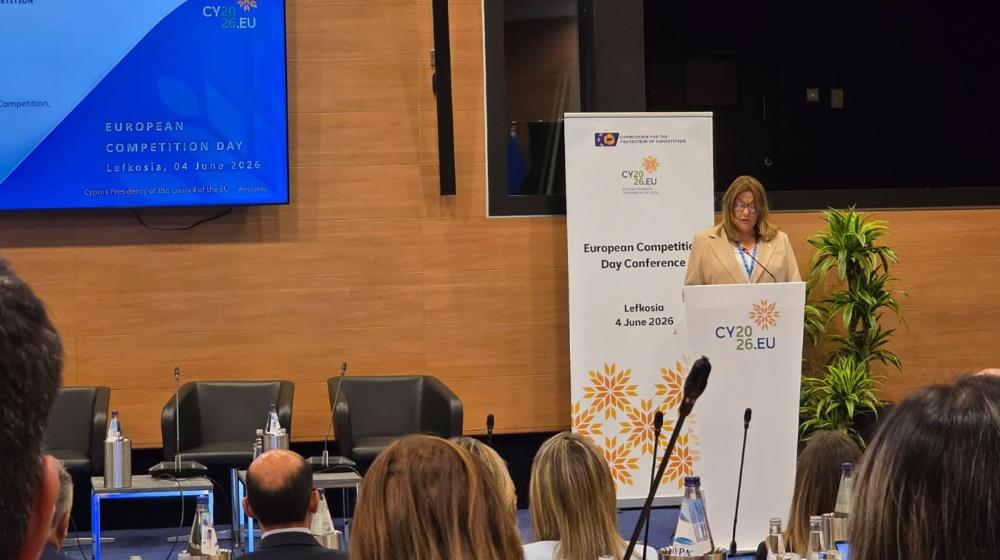
European competition policy must remain effective, predictable and able to respond to rapidly changing markets, officials said during a European Competition Conference, held in Nicosia, in the framework of the Cyprus Presidency of the Council of the EU.
Opening the conference on 4 June, Eva Pantzari, Chairperson of the Commission for the Protection of Competition of the Republic of Cyprus, said the event offered an opportunity to reflect on the present and future of competition enforcement in the European Union.
She said competition law was closely linked to the internal market, as it protects the competitive process, prevents distortions, safeguards openness and supports innovation, investment and consumer choice.
Pantzari noted that at a time of economic uncertainty, technological change and geopolitical pressure, effective competition enforcement was “not a luxury” but an essential component of economic resilience, particularly for small and open economies such as Cyprus.
Cyprus, she said, faces challenges linked to limited market size, sectoral concentration, dependence on imports, transport and energy costs and exposure to external shocks. In such circumstances, she added, competition enforcement must be rigorous where required, but also grounded in evidence, economic reality and procedural guarantees.
Referring to the agenda of the conference, Pantzari said discussions would focus on abuse of dominance, merger control, judicial insights on EU competition law and the consumer goods dimension of competition enforcement in the single market.
She also said that the Cyprus Commission for the Protection of Competition remained committed to active participation in the European Competition Network and to closer cooperation with the European Commission and other national authorities.
Fair competition “the backbone of the European economic model”
Addressing the conference, Permanent Secretary of the Ministry of Energy, Commerce and Industry, Kyriakos Iordanou, said fair competition was “the backbone of the European economic model” and ensured that innovation thrives, consumers benefit and businesses compete on merit rather than market power.
He said the EU must safeguard the internal market while also remaining competitive globally, amid geopolitical volatility, changes in trade, sanctions, protectionism, tariffs and uncertainty over energy and fuel supply and prices.
Iordanou said the EU was advancing its competitiveness and strategic autonomy through initiatives such as the Single Market Strategy, the Foreign Direct Investment Screening Regulation, the Foreign Subsidies Regulation, the Digital Markets Act and revised merger guidelines.
He also referred to recent developments in the technology sector, including Chips Act 2.0 and the Cloud and AI Development Act, saying they were expected to place Europe on a different footing in global competition.
The biggest overhaul of the EU merger framework
In a video message, Anthony Whelan, Director General for Competition at the European Commission, said the draft new EU Merger Guidelines, published for public consultation on 30 April, represented the biggest overhaul of the EU merger framework in the past two decades.
He said the new approach would focus less on categories of mergers and more on their effects, while also placing greater emphasis on dynamic assessments, including innovation, future competitive constraints and potential pro-competitive benefits.
Whelan said the Commission aimed to have the final merger guidelines in place by the end of the year, following feedback due by 26 June.
He also said the Commission expected to adopt, after the summer, its first guidelines on exclusionary abuses of dominance under Article 102 of the Treaty on the Functioning of the European Union.
Referring to enforcement, Whelan said cases linked to the integration of the single market remained a priority, particularly in consumer goods markets, where territorial supply constraints can prevent distributors from sourcing products from Member States where prices are lower.
He said more action from DG Competition should be expected in this area, adding that while such cases may be “less flashy” than digital ones, they were “extremely important for citizens’ wallets.”
The Republic of Cyprus currently holds the Presidency of the Council of the EU for a six-month term that started on January 1st, 2026, as part of a Trio Presidency along with Poland and Denmark.
(Source: CNA)
