







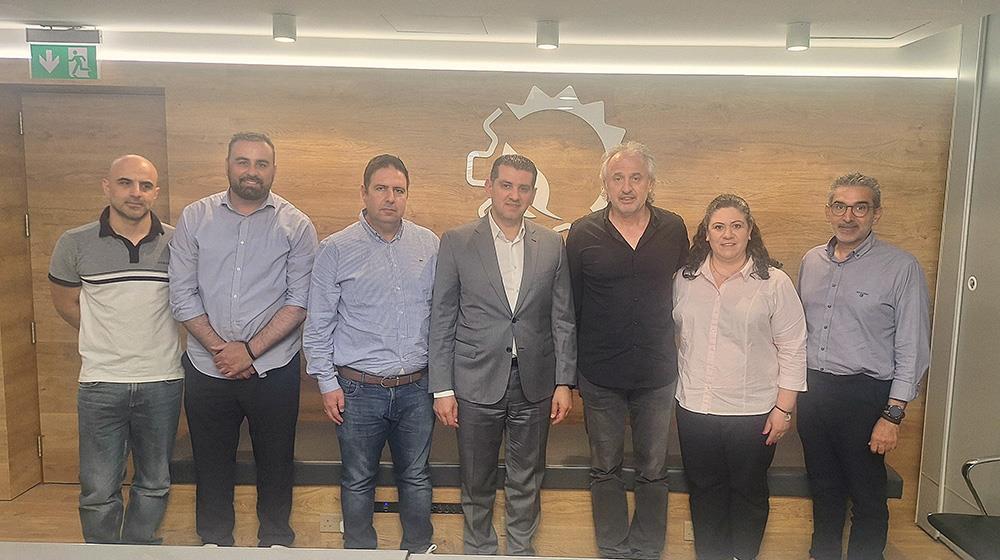
Important issues concerning the country's energy security, the smooth functioning of the electricity market, the green transition and the need for better coordination between the relevant bodies were raised at a meeting held by the Cyprus Scientific and Technical Chamber (ETEK), headed by its President Constantinos Constanti, with the Minister of Energy, Commerce and Industry, Michael Damianos.
During the meeting, ETEK underlined that Cyprus is facing critical decisions and challenges, which require coordinated action. Special reference was made to the Great Sea Interconnector project, with the Chamber emphasising the need for proper management of geopolitical data and minimizing the risk that the Cypriot electricity consumer and/or the Republic of Cyprus has already undertaken.
A significant part of the discussion was dedicated to the natural gas terminal in Vasiliko. The Chamber noted that this is an unfinished and problematic project, which requires a clear roadmap and acceleration of the next steps. In particular, ETEK pointed out that, despite the delivery of a gap analysis study by project manager Technip to the Natural Gas Infrastructure Company (ETYFA), delays and difficulties in decision-making are still observed.
ETEK also raised the issue of outages in residential photovoltaic systems and the slow pace of introducing flexibility elements into the electricity system. Special reference was made to the progress in integrating storage systems into the grid and more generally to the progress in installing storage in the electricity system. In this context, it was emphasized that the actions for the integration of dynamic pricing, storage, demand response, electric vehicles and digitalisation of the grid are moving at a slower pace than the increasing penetration of photovoltaics. As it was pointed out, if the modernisation of the system is not accelerated, the problem of outages will become even more acute.
At the same time, the Chamber highlighted the need for effective implementation of the Energy Efficiency First principle. In a country with a large number of low-energy buildings, energy saving should be a top priority of energy policy. ETEK noted the delays in the announcement and implementation of grant schemes, including the “Save – Upgrade” scheme, as well as the schemes of the Special Fund for Renewable Energy Sources (RES) and Energy Storage Solutions (ESS). Particular emphasis was placed on the need to support vulnerable groups and to address energy poverty.
In the context of the discussion, the need to institutionalise a permanent Committee of Technocrats and involve market actors was noted, with the aim of structured and systematic discussion of energy issues and finding workable solutions in relation to issues related to energy poverty, support for self-consumption, energy communities and the rights of active customers. As noted, the absence of adequate coordination leads to fragmentation, delays and unsatisfactory results.
ETEK also brought up the need to establish an Energy Strategy Council, which will, among other things, monitor the implementation of the strategic plan and support the country's long-term energy planning and its implementation. Particular reference was made to the need to prepare scenarios for cases of significant delay or non-implementation of projects of strategic importance, such as the Great Sea Interconnector or the advent of natural gas.
(Source: InBusinessNews)
