






The new Multiannual Financial Framework will include flexibility measures to make EU’s crisis respond fast and effective, Commissioner for Budget, Anti-Fraud and Public Administration, Piotr Serafin, and Cyprus’ Deputy Minister for European Affairs, Marilena Raouna, have said.
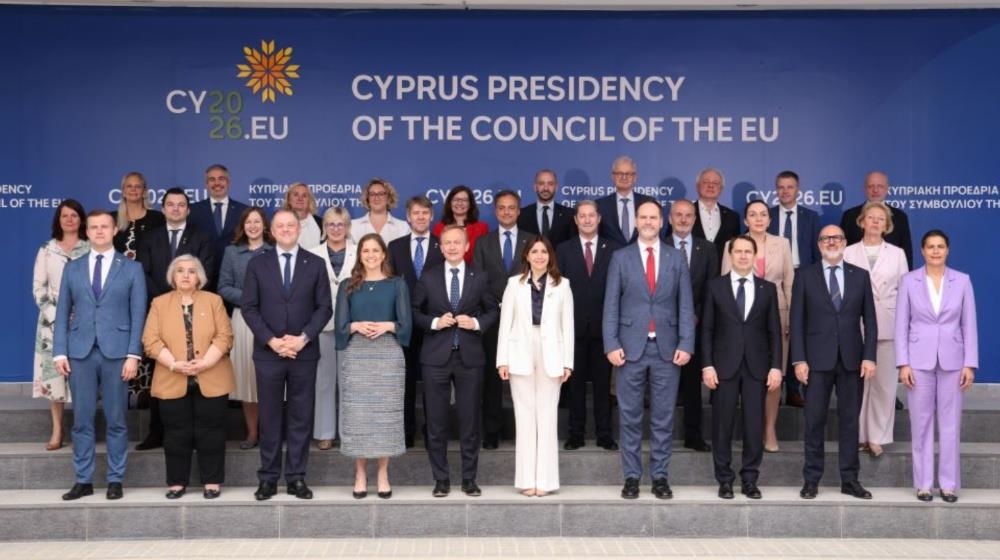
They were speaking at a press conference, following the conclusion of the Informal Meeting of the Ministers of European Affairs, held in Nicosia on 11 May.
As the Commissioner explained, the new MFF will include the crisis mechanism that could be activated by qualified majority voting, instead of unanimity, calling the process “an opportunity, not a risk factor”.
According to Raouna, the Ministers discussed the MFF, EU’s enlargement process, with the participation of candidate countries and potential candidate countries, and a discussion on EU’s cooperation with UK, with the participation of UK’s Minister for the Constitution and European Union Relations.
“Today's meeting provided an important opportunity to reflect together on how we can continue advancing in tangible ways, in results-driven ways, the guiding vision of our presidency, which is a more autonomous union open to the world,” Raouna said, adding that the Ministers today had the opportunity to exchange views openly and constructively on some of the key issues shaping the Union's future.
An MFF capable of responding to crises
On the new MFF, Raouna said that the exchange of views confirmed the need for a long-term budget that will enable the EU to respond decisively and effectively to unforeseen circumstances, geopolitical developments and crises. “This is particularly relevant nowadays as we are faced with an increasing number of broad and high-scaled crises, ranging from natural disasters to migration to health, including animal health, and hybrid threats, which was a point raised by a number of member states,” she said.
According to Raouna, the discussion touched upon the overall flexibility of the new budget, as well as dedicated instruments for crisis prevention and response. “The proposal by the Commission has taken on board the lessons learned and the experience from previous crises during the current MFF. There are varying views on the modalities and governance of the proposed mechanisms. At the same time, there is a very strong shared aspiration towards a Union that acts swiftly, effectively, and with solidarity in case of crisis”, she said.
Raouna added that the Cyprus’ Presidency will continue to work on defining the right balance between flexibility and predictability of long-term investments, and pointed out that the new MFF is among the top priorities of the Cyprus Presidency.
“We have been working hard since day one, hand in hand with Member States, with the European Commission, working closely with the European Parliament on all fronts with a view to reach an agreement on the MFF by the end of 2026," she noted.
"This is the mandate that we have received by the European Council. To this end, our two key goals on the file are first, inserting the first figures in the negotiating box, and second, achieving an agreement in the Council on key sectoral files,” she said.
On his part, Commissioner Serafin said that the debate today has confirmed the basic assumption on which Commission’s proposal was built, that the current financial framework is too rigid to respond effectively and decisively to fast-moving crises. “That is exactly the reason why we have put a number of flexibility measures into the proposal of our MFF, including the crisis mechanism,” he said.
He stressed that, when confronted with crisis, the ability of the European Union to act decisively and quickly is of utmost importance.
“In the last few years, we have experienced situations where one could have doubts whether the veto power was used to defend legitimate national interests or rather was used as a tool of a blackmail. Let me remind you that both in 2024 and this year, the MFF regulation had to be changed unanimously to allow the EU to act decisively in view of the geopolitical and security urgency," he noted.
According to Serafin "we should be better prepared for such scenario in the future."
"The crisis mechanism that could be activated by qualified majority voting is, from that perspective, an opportunity not a risk factor. Instead of talking about its elimination, we should rather be talking on how to strengthen it,” he noted.
Enlargement as a strategic investment in Europe’s security
The second issue on the agenda was the enlargement process. Raouna said that in today's challenging geopolitical and security environment, enlargement “is a strategic investment in Europe's security, resilience, and unity. A more autonomous Union is an enlarged Union.”
However, she added that geopolitical urgency does not in any way lower the bar for accession. “The fundamentals remain central to accession negotiations. Rule of law, democratic institutions, fundamental rights, judicial independence, media freedom, public administration reform, and economic governance. These are not technical requirements. They are essential safeguards for resilient democracies and secure societies, and there are no shortcuts,” she stressed.
She reiterated that enlargement is and must remain merit-based, with credible reforms and measurable progress being the best guarantee that enlargement will strengthen the Union's unity, effectiveness, and global role.
Commissioner Serafin noted that with Russia's aggression against Ukraine, the geopolitics is back on the European continent. “We all know that the enlargement is the most powerful tool that we have at our disposal, the tool that can strengthen our security and prosperity. But we also want the enlargement that is making the EU stronger," he said.
And that, he pointed out, "is exactly why we need to preserve a merit-based accession process, assessing together with the candidate countries' progress in the reforms that are useful and beneficial also from their perspective.”
He added that the Meeting discussed the gradual integration, noting that it should be seen as a way to bring in certain benefits of membership even before the formal conclusion of the accession negotiations, without it being seen as an alternative to the enlargement.
Asked about the discussion on gradual integration, the Commissioner said that “I think there is quite a broad support, both from the candidate countries and also from the member states of the EU. There has always been a concern that gradual integration could be presented as a tool to replace the enlargement, and I think we clarified and we will continue to clarify that the idea is different. The idea is to offer benefits of membership in specific areas of integration even before the formal accession negotiation process is completed.”
He further noted that EU has a group of knowledgeable and experienced experts in drafting accession treaties. “They had nothing to do for the last 14 years, but that changes this week, also thanks to the Cypriot Presidency. They are starting to draft again. Therefore, I would like to say we keep fingers crossed for the first ad hoc working party on the drafting of the accession treaty with Montenegro that is going to take place exactly this week,” he concluded.
Asked on Ukraine’s accession process, Raouna said that “we have advanced the technical work at the Council, at the technical level, working hand in hand with the European Commission”. She commended Ukraine because “in the face of the Russian war of aggression, they have consistently exerted every effort to deliver on the crucial reforms that are required for accession negotiations to progress”.
She said that in the margins of the informal General Affairs Council in March the Commission presented the work on the benchmarks for clusters 3, 4, and 5, for Ukraine and Moldova. “With that, we've completed the technical work,” she said, noting that the Cyprus Presidency has been working, and continues to work to build consensus that will allow for the green light to be given.
“We are ready, when that consensus is there”, she said, noting that as Presidency, we would want to have that as a deliverable. She noted that both President of the Republic, Nikos Christodoulides, and Foreign Minister, Constantinos Kombos have had a communication with the new leadership in Hungary.
On the financial dimension of Ukraine’s accession, Commissioner Serafin said that Ukraine is the only candidate country that has a specific space in the future MFF. “We have put aside so-called Ukrainian reserve, which is over and above the ceiling of the future MFF”, noting that the necessary resources for reconstruction of Ukraine, but also for the gradual integration of Ukraine, will be there. “We will also be able to find with the Global Europe Fund necessary resources to ensure gradual integration also of other of our candidate countries” he said.
EU-UK cooperation
Deputy Minister Raouna, also said that the informal Council held an exchange with the UK Minister for the Constitution and European Union Relations, Nick Thomas-Symonds on countering information manipulation and interference, “a growing and cross-cutting challenge for our democratic societies”.
Noting that the UK is a natural ally, Raouna pointed out that there is renewed momentum essential to cooperate with partners in this current environment. “Our discussion reaffirmed that Foreign Information Manipulation and Interference (FIMI) is a shared and evolving threat that requires closer coordination both within the European Union and with like-minded partners such as the UK, which brings valuable expertise and experience in this area.”
She added that building on the work of the first EU-UK summit, the Security and Defence Partnership Agreement, “we look forward as Presidency to continue delivering on this partnership dynamically focused and in a mutually beneficial way.”
Commissioner Serafin said that the presence of UK’s Minister was relevant, since “the UK is our tested and trusted ally in all security-related issues, and FIMI is one of them.”
He expressed hope that today's exchange will strengthen EU-UK cooperation even more. “From the Commission’s side, we could even conclude today's exchange as a mandate for even deepening cooperation with the UK in this area,” he said, congratulating the Cyprus’ Presidency for the initiative to invite the UK back to the room.
(Source: CNA)
