






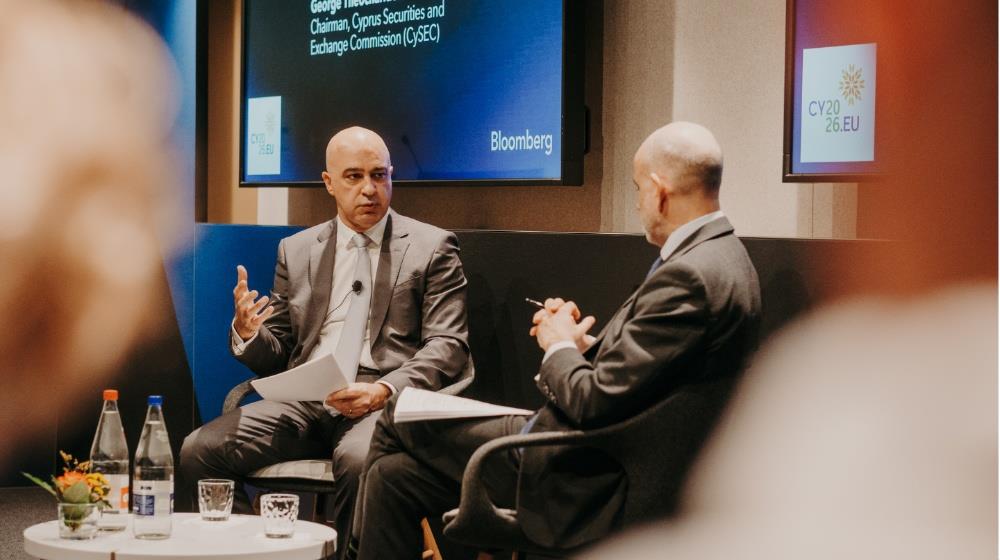
The Financial sector could serve as the “engine” of transformation, CySEC Chair George Theocharides has said.
He was speaking at the Bloomberg EU Policy Series event in Brussels on 9 February, held under the framework of the Cyprus Presidency of the Council of the EU.
The event focused on the need to build a more competitive, autonomous, and innovative European economy and Theocharides was the keynote speaker.
Theocharides noted that Cyprus assumes the Presidency “at a pivotal moment for Europe,” emphasising that the motto “An autonomous Union, open to the world” represents a strategic imperative in an environment of geopolitical shifts and rapid technological developments.
He underlined that Europe “must be competitive enough to lead, autonomous enough to protect its interests, and innovative enough to shape the future,” highlighting that the financial sector serves as the “engine” of this transformation.
A central point of his intervention was the Savings and Investment Union and the market integration and supervision package proposed by the European Commission.
The CySEC Chair highlighted a structural weakness that has remained unresolved since the first discussions on the Capital Markets Union in 2014-2015, the continued fragmentation of European capital markets.
He went on to say that legal, supervisory, operational, and sometimes cultural barriers still make cross-border investment in the EU more difficult than it should be.
Theocharides stressed that this fragmentation increases the cost of capital for European businesses, limits the growth trajectory of innovative companies, and pushes businesses to seek funding outside the EU.
He also noted that it creates inefficiencies for savers, who face limited choices and uneven protections depending on their member state of residence. The Commission’s proposals, he said, aim to create a more efficient, competitive, and resilient European financial ecosystem.
The CySEC Chair made particular reference to the dimension of strategic autonomy, noting that a deeper and more liquid European capital market reduces reliance on external sources of capital and bank lending, thereby strengthening the financial sovereignty of the euro area without isolating Europe from the world.
In the same context, he underlined that the Union’s largest untapped resource is the private savings of its citizens, which amount to €14 trillion.
As he noted, a significant portion of this remains in low-yield deposits, which in an era of inflation and demographic pressures is not a sustainable model for wealth creation or retirement security.
He stressed that the Savings and Investment Union, combined with reforms in pensions, insolvency, and market access, can safely and transparently channel part of these savings into productive investments, contributing to closing the investment gap necessary for the green, digital, and defense transitions.
At the same time, he underlined that autonomy must never turn into protectionism, noting that the EU must maintain credible equivalence frameworks with other jurisdictions and predictable rulemaking.
Cyprus, he said, due to its geographical position and experience, can act as a bridge between Europe, the Middle East, and Africa, supporting a regulatory environment that is strict where needed but open where possible.
Referring to the implementation of market integration, he noted that this does not end with legislation alone but also requires supervisory convergence, ensuring that rules are applied consistently across all member states.
As priority areas during the Cypriot Presidency, Theocharides mentioned, among others, digital finance and innovation. Frameworks such as the Markets in Crypto-Assets Regulation (MiCA), he noted, are not only about regulating new asset classes but about providing clarity and establishing the EU as a credible center for innovation.
He also referred to the Digital Operational Resilience Act (DORA), noting that it strengthens the resilience of the financial system against systemic cyber threats.
Special reference was made of the package for combating money laundering and the new European architecture through the creation of the Anti-Money Laundering Authority (AMLA). He added that it aims to establish a new European framework to fight money laundering and terrorist financing, including areas connected with crypto transactions.
Regarding sustainable finance, he spoke of the need for effective implementation of the Sustainable Finance Disclosure Regulation (SFDR) and the Corporate Sustainability Reporting Directive (CSRD), aiming to prevent “greenwashing” without excessive complexity, especially for small and medium-sized enterprises.
In the same context, he referred to the retail investment strategy, noting that individual investors must participate with confidence, through understandable products, meaningful disclosures, and credible enforcement.
The CySEC Chair also addressed regulatory simplification, clarifying that it does not mean deregulation but rather “smarter regulation” and proportionate supervision, reducing administrative burdens, particularly for SMEs.
He emphasised the importance of financial literacy and investor protection, referring to the growing influence of “financial influencers” and online scams.
Theocharides finally noted that Cyprus is ready to work with member states, institutions, regulators, market participants, investors, and citizens to build a Europe that is more competitive, more autonomous, more innovative, and open to the world.
(Source: CNA)
