







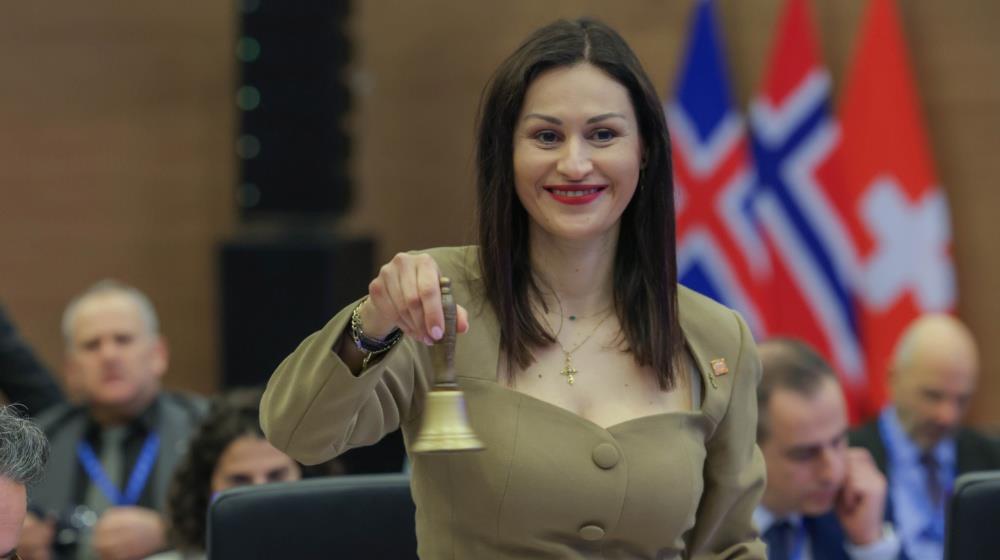
The importance of the alignment between legislation and funding, across sectors, and between EU and national policies was highlighted by the Minister of Agriculture, Rural Development and Environment, Maria Panayiotou, at the Informal Council of Environment Ministers.
The meeting was held in the context of the Cypriot Presidency of the Council of the European Union, in Nicosia on Friday, 6 February. The Minister noted that climate resilience must be integrated into every relevant law and policy.
Friday’s first session focuses on the tools needed to build a resilient Europe and on how legislation and finance can support a coherent, cross-sectoral approach to climate and water resilience.
Strengthening cross-sectoral coordination
Panayiotou invited Ministers to reflect on how the EU and Member States can strengthen cross-sectoral coordination to better align climate and water resilience efforts and how a shared EU-level understanding of future climatic conditions can support timely and coherent action.
“We will also discuss how the Integrated Framework for Climate Resilience and the Water Resilience Strategy can be implemented in a fully synergistic manner to deliver lasting results towards the EU’s 2030 and 2050 objectives, and how effective funding mechanisms, including private and EIB financing, can be mobilized to support integrated resilience investments, particularly in the most vulnerable regions,” she said.
The Minister referred to the 5 February on-site visit to Delikipos park, noting that the informal exchanges of views provided a valuable opportunity for reflection and dialogue, ahead of substantive policy discussions at the Council on 6 February.
“Cyprus, as an island Member State of the European Union, located at the southeastern edge of the Mediterranean and at the external borders of the Union, is already facing significant challenges related to climate and water resources,” she said, noting that Cyprus is placed on the frontline of the climate crisis. Rising temperatures, prolonged periods of drought, water scarcity, and increasingly frequent extreme weather events are no longer future risks, but present realities, she mentioned, adding that these challenges are not theoretical, but have a direct impact on society, on the economy, and our future. “For this reason, for Cyprus, the environmental and climate agenda is not merely a policy choice, but a political necessity,” she stressed.
These challenges, however, are not confined to the Mediterranean alone, she continued. They reflect pressures that are becoming increasingly evident across Europe as a whole, reinforcing the need for a common, long-term, and forward-looking approach to resilience. This approach is encapsulated in the central motto of Cyprus’ Presidency, “A Resilient European Union, Open to the World,” which underscores a European Union that is more resilient, more self-reliant, and better prepared, while at the same time remaining outward-looking and actively engaged on the international stage, Panayiotou noted.
Building a resilient Europe
Referring to the first thematic session of the agenda, she said the need to build a resilient Europe and to align water and climate resilience in a coherent and mutually reinforcing manner, for the benefit of the citizens and the environment lies at the core of the Cyprus Presidency’s priorities.
She added that Europe is already living in a warmer world. The average global temperature has risen beyond 1.5 degrees Celsius above pre-industrial levels, and the impacts are no longer distant projections, they are happening now. “Our continent is facing multiple climate risks that have already reached critical levels. Without rapid mitigation, adaptation, and resilience action, many of these risks will intensify and could become critical by the end of this century,” she said.
As she noted, the economic cost is clear. Since 1980, the EU has recorded losses of €822 billion from extreme weather events, with €208 billion incurred between 2021 and 2024 alone, over a quarter of all losses since monitoring began. “This is not only a climate crisis; it is also a security and economic crisis,” she stressed.
The Minister continued that water is at the heart of this challenge, as the most essential resource and a cross-cutting factor in key sectors of society. “Climate change is driving a range of extreme phenomena, including droughts, extreme rainfall, glacier melt, permafrost thaw, and sea-level rise. Water connects ecosystems, infrastructure, health, agriculture, energy, and tourism. It is a fundamental element of climate resilience, and strengthening water resilience is therefore essential to protect our citizens and our economy,” Panayiotou noted.
The EY as a frontrunner in climate and water resilience
According to the Minister, the European Union has set a clear objective: to become a frontrunner in climate and water resilience. Significant progress has already been made, she said, mentioning the EU Adaptation Strategy and the Commission’s recently adopted Water Resilience Strategy. “The Commission is now preparing an Integrated Framework for Climate Resilience, including a legislative proposal, to drive transformational change across the Union,” she added.
“Yet, our ambition must be matched by alignment — alignment between legislation and funding, across sectors, and between EU and national policies. We must ensure that climate resilience is integrated into every relevant law and policy, with clear responsibility for risk ownership. We must also ensure that finance — both public and private — is available where it is most needed, especially in the most vulnerable regions,” she continued.
Referring to water scarcity, she said that it is already a reality. “The State of Water report shows that about 30% of EU territory and 33% of the population are affected every year. Southern Europe is particularly exposed, with permanent water scarcity affecting agriculture, public water supply, tourism, and energy,” she noted, stressing that Cyprus faces particularly acute and compounding challenges from climate change due to its semi-arid climate, geographic isolation and high dependence on limited and climate-sensitive freshwater resources.
Rising temperatures, prolonged droughts and increasing aridification are intensifying chronic water scarcity, affecting households, agriculture, tourism and energy production, while extreme weather events place growing pressure on infrastructure and ecosystems, she continued.
“As an island with no transboundary rivers and limited natural water storage, Cyprus has constrained adaptation options and higher costs for securing water supply, including reliance on energy-intensive desalination. These structural vulnerabilities make climate and water resilience not only an environmental priority but also a matter of economic stability and security, underscoring the urgent need for targeted EU support, integrated planning, and sustained investment in resilient water management, nature-based solutions and climate-proof infrastructure,” Panayiotou said.
Therefore, she concluded, “the question before us is not whether we need to act — but how we act together.”
(Source: CNA)
