







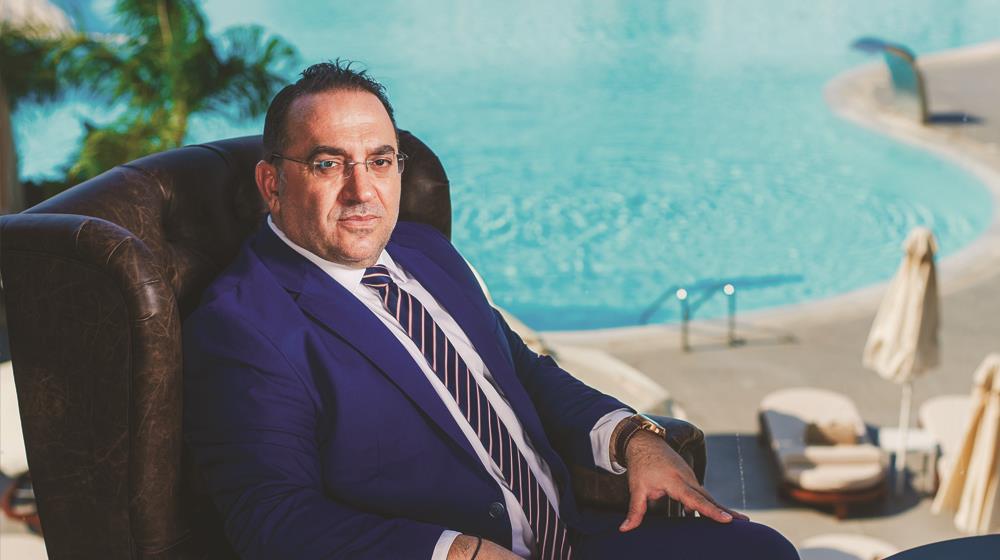
Tourism is being redefined internationally, with Cyprus following suit and Deputy Minister of Tourism, Kostas Koumis, has revealed the strategic choices, responsibility, and long-term planning that goes beyond numbers, all while keeping an eye on the next ten years.
In an interview with IN Business magazine, he also refers to the Cypriot Presidency of the Council of the EU, which he describes as a first-class opportunity to highlight Cyprus as a destination.
Deputy Minister, let's start with the National Tourism Strategy 2035? What does it encompass, and what is its aim?
The National Tourism Strategy 2035 is essentially the roadmap for the 'next day', the next decade of our sector. It is the result of consultation with the entire tourism ecosystem and other involved ministries and aims to gradually make our country a year-round tourist destination, accessible to all, with the resulting benefits spreading to local communities. It encapsulates, with specific goals and steps, our vision for tourism, which we seek to maintain in its role as a central pillar of the economy and, of course, to continue to be a driving force for the creation of new jobs and development. This will be development that will respect the natural and cultural environment of our country and will be based, as I have already mentioned, on local communities and the people who either operate or work in the sector. Through the new updated strategy, we essentially assume responsibility for planning the sector for the next decade.
What role will Cyprus' assumption of the Presidency of the Council of the EU play? How much will we gain in terms of numbers and visibility as a country?
The assumption of the Presidency of the Council of the European Union by the Republic of Cyprus is clearly the biggest challenge for 2026, not only in terms of tourism but in all sectors. The benefits are many and significant, since the spotlight of the whole of Europe is turned towards our country and it is certainly a first-class opportunity to highlight Cyprus as a destination.
In terms of hospitality, we are ready to serve the increased needs that are arising, with the arrival of 30,000 delegates who will participate in the meetings of all levels that have been scheduled during the Presidency period.
What should we expect to be particularly significant in matters related to tourism policy?
With regard to tourism policy issues, the holding of the Informal Meeting of the Ministers of Tourism of the European Union next April is considered very important, at which the final consultation on the formulation of the first European tourism strategy is expected to take place. This is a strategy that is an initiative of the Commissioner responsible for Sustainable Transport and Tourism, Apostolos Tzitzikostas, and aims to align the tourism ecosystem throughout the EU territory. The aim is to achieve further development of the sector throughout the length and breadth of the Union with respect for the principles of sustainability.
Nicosia has a lot to gain from the presence of visiting Europeans, but it has not historically been one of the first choices for foreign visitors. Do you have any suggestions to change this situation?
It is a fact that Nicosia has not yet developed into a popular tourist destination and this is clearly not in the interest of our country's tourism. However, I must say that developments in the right direction have been taking place recently. In particular, the doubling of beds within a two-year period with the creation of at least four new units will decisively contribute to the emergence of the city as a tourist destination.
Which foreign visitors can the capital target?
The capital has the potential to evolve into an attractive alternative destination for city tourism and MICE (meetings, incentives, conferences, exhibitions). It can also put emphasis on gastronomy well, as it has already been awarded as Culinary Capital 2024 by the World Food Travel Association. Through cooperation with local authorities and the private sector, I believe that Nicosia can have its own share of the increased visitor flows.
Airports Council International announced that Cyprus was second in Europe in improving air connectivity from 2019 to 2025. What are we doing to continue this trend?
First of all, let me mention that this distinction specifically concerns direct air connectivity and not general. In fact, Cyprus ranks first among EU+ countries in the 2024-2025 comparison with an increase of 18%. Significant steps have been taken in this area and we are constantly in contact with airlines to strengthen their flight schedule to Cyprus.
What is the Deputy Ministry of Tourism doing within the framework of its responsibilities and what will we see changing in 2026?
The significant development resulting from the increase in flights from Germany - Berlin, Cologne, Düsseldorf and Munich - announced by Lufthansa and Ryanair is worth noting. This is a market that has been our long-term goal to win over and 2025 recorded a record number of visitors after 28 years, with 277,905 visitors. With the existing conditions and the already increased connectivity, there are prospects for further growth. Flights from the United Kingdom and Switzerland to our country, as well as other countries, will also be improved, as has already been announced.
Regarding business travel, beyond leisure travel, can Cyprus claim another piece of the pie?
The development of special forms of tourism is a priority for the Deputy Ministry as it is also the prevailing international trend among visitors, who are now seeking authentic experiences in their travels. Also, special forms of tourism are the key to the gradual transformation of Cyprus into a year-round tourist destination, extending the tourist season beyond the sun and sea, strengthening the economy and attracting different audiences.
And how can Cyprus become a year-round destination?
Through targeted incentive plans, where emphasis is placed on the winter months and the mountainous areas of our hinterland, we are promoting forms of tourism such as sports, with the relevant plan for the descent of teams from abroad for preparation having been utilised by over 100 teams and federations, as well as conference (MICE), cultural and gastronomic tourism. We have submitted a bill regulating diving tourism and, at the same time, presented a study for the development and promotion of this form of tourism, something that will also be done within the year for other forms such as Health Tourism and Nature/Rural Tourism.
A perennial problem for the hotel industry is that a large number of arriving tourists do not stay in licensed accommodations. What do you have to say to the hotel sector about this?
Look, a percentage in every country, in every destination, has visitors choosing not to stay in tourist accommodations. They choose to stay with relatives or friends, in privately owned homes. In our country, there are thousands of people who have invested in holiday homes, and certainly some stay in self-catering accommodations.
In Cyprus, for years, until 2023, the percentage of people not staying in tourist accommodation exceeded 30% and in some cases reached 34%. In 2024, it decreased for the first time to 25%. Here I should mention that Cyprus, according to Eurostat, in 2024 was the country with the largest increase in overnight stays in accommodation across Europe and specifically recorded an increase of 14.5%. Indicatively, I should mention that the European average for the same period was 2.7%.
In a previous interview, you mentioned that the Deputy Ministry is focusing on improving tourism services. What does an “improved” service mean to you?
Tourism is a very dynamic sector, with new trends emerging very frequently and being influenced daily by external factors that are often difficult to predict. Therefore, today's success and the complete satisfaction of the results of the tourism industry as a whole do not ensure tomorrow's success.
What should be done about this?
The sector as a whole must evolve and seek to upgrade the product it provides so that it remains attractive to visitors. The integration of new technologies, the improvement of infrastructure in individual destinations and the encouragement of the adoption of environmentally friendly practices, the promotion of authentic Cyprus through civilization, culture and especially local gastronomy, and of course the upgrading of human resources skills are factors that contribute to improving the visitor experience, which is the ultimate goal.
Personally, I would like to see the entire tourism ecosystem of our country definitely invest in sustainable practices, but also in local gastronomy.
I believe that local gastronomy continues to hide treasures that have not yet been showcased as they deserve. And in this direction, we are preparing something again, which will be implemented in 2026.
(Source: INBusiness magazine)
