






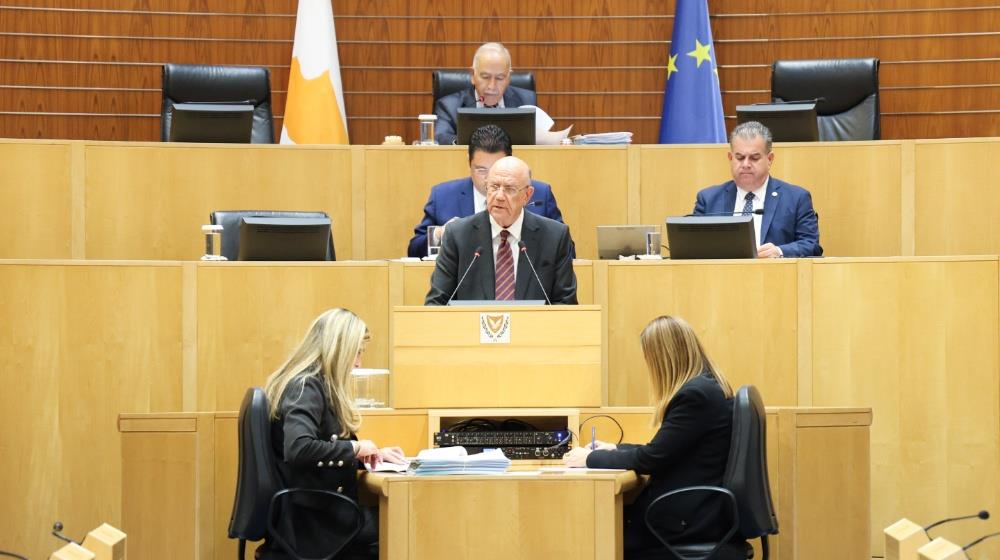
Cyprus’ state budget for 2026 is designed to meet the evolving challenges of the current economic situation while strengthening growth and maintaining a strong social footprint, Finance Minister Makis Keravnos has told the plenary of the House of Representatives, presenting the third budget of the Christodoulides administration.
“The 2026 state budget and the Medium-Term Fiscal Framework are a concrete demonstration of our commitment to stable growth, fiscal responsibility and social progress,” Keravnos said on 4 December, noting that the new budget has been drafted under the EU’s revised Economic Governance framework adopted in June 2024.
He stressed that the government’s objective is to reinforce economic expansion “from which as many of our fellow citizens as possible can benefit,” following a model of inclusive and balanced development.
Despite persistent global turbulence, the Finance Minister said the Cypriot economy continues to show resilience, supported by strong growth, low unemployment and sustainable public finances. The ongoing war in Ukraine and rising protectionism in global trade, he said, continue to create uncertainty, but Cyprus is projected to preserve its growth momentum.
The 2026 budget provides for €10.7 billion in primary expenditure, an increase of €508 million or 5% year-on-year. Development spending is set to rise by 4.7% in 2026, while social benefits will increase by 6.7%, covering spendings in education, health and social welfare.
Keravnos said that between 2026 and 2028, the government will channel €6.82 billion in support to vulnerable groups, students, children, patients and persons with disabilities. This includes €615 million for the Guaranteed Minimum Income, €412.4 million for child benefits, €338.5 million for the social pension, €285 million for pensioner allowances, €286 million in housing support, €144 million in student grants and €106 million for new disability benefits.
He pointed out the necessity of maintaining fiscal surpluses “to respond to unexpected events, which have become far more frequent,” calling for the continuation of prudent economic policy.
Growth and fiscal outlook
According to the Ministry’s projections, Cyprus’ GDP growth is expected to reach 3.1% in 2026, ease to 3.0% in 2027 and reach 2.9% in 2028. Unemployment is forecast at 4.6% in 2026–27 before edging down to 4.5% in 2028, reflecting conditions of near-full employment.
Inflation is projected to stabilise close to 2% over the medium term. The 2026 fiscal balance is expected to post a surplus of 2.9% of GDP, with the primary surplus reaching 4.3%. Public debt is projected to fall to 50.9% of GDP in 2026, down from 55.3% in 2025, well below the initial target of 60% by end-2026.
Keravnos pointed to an upbeat assessment by the European Commission under the European Semester, noting that GDP growth reached 3.6% in the first half of 2025, investments rose by 10.4% and fiscal surpluses remained strong.
Reforms, tax overhaul and EU-funded investments
The Finance Minister stressed that the government is advancing a broad reform agenda aimed at modernising society, supporting entrepreneurship and improving living standards. Central to this, he said, is the tax reform package now before Parliament.
Keravnos noted that Cyprus has so far received €568 million in Recovery and Resilience Facility funds—46.6% of the total envelope. The sixth disbursement of €61 million is under evaluation, with another request planned before year-end, bringing Cyprus closer to the EU average absorption rate of 56%.
He also stressed the importance of a robust financial system able to support households and businesses “without repeating the risks of the recent past.”
Describing the 2026 budget as “an investment in the country’s future,” Keravnos urged MPs to approve it, saying it paves the way for “a stable, creative and optimistic future for our citizens, businesses and future generations.”
(Source: CNA)